When is underpinning needed? Only when foundations are genuinely inadequate: movement that continues after the cause (drains, trees) has been removed, footings demonstrably too shallow for their ground conditions, or loads changed by major works. Industry experience is that most investigated subsidence resolves without it. Underpinning should be the conclusion of investigation and monitoring — never the opening quote.
The methods compared
| Method | How it works | Best suited to |
|---|---|---|
| Mass concrete (traditional) | Sequential pits under the footing filled with concrete, taking foundations deeper | Housing, depths to ~2m, accessible sites |
| Beam and base | Reinforced beam under the wall spreading load onto pads or piers | Where continuous digging is impractical |
| Mini-piled | Small-diameter piles carry loads past problem soils to competent strata | Deep problems, restricted access, variable ground |
| Resin injection | Expanding geopolymer improves ground beneath footings | Suitable soils; fast, low-disruption alternative in appropriate cases |
Method selection is an engineering decision from ground investigation — not a menu choice.
What it costs
UK indicative rates: mass concrete roughly £1,500–£3,000 per linear metre; beam-and-base £2,000–£3,500/m; mini-piled £2,500–£4,500+/m. Whole-project ranges run from ~£10,000 for short runs to £50,000+ for multiple elevations — before design fees, party wall costs, possible temporary accommodation and reinstatement. Where subsidence is a valid insurance claim, insurers commonly fund necessary underpinning. All figures are planning indications; engineered design produces real numbers.
The process
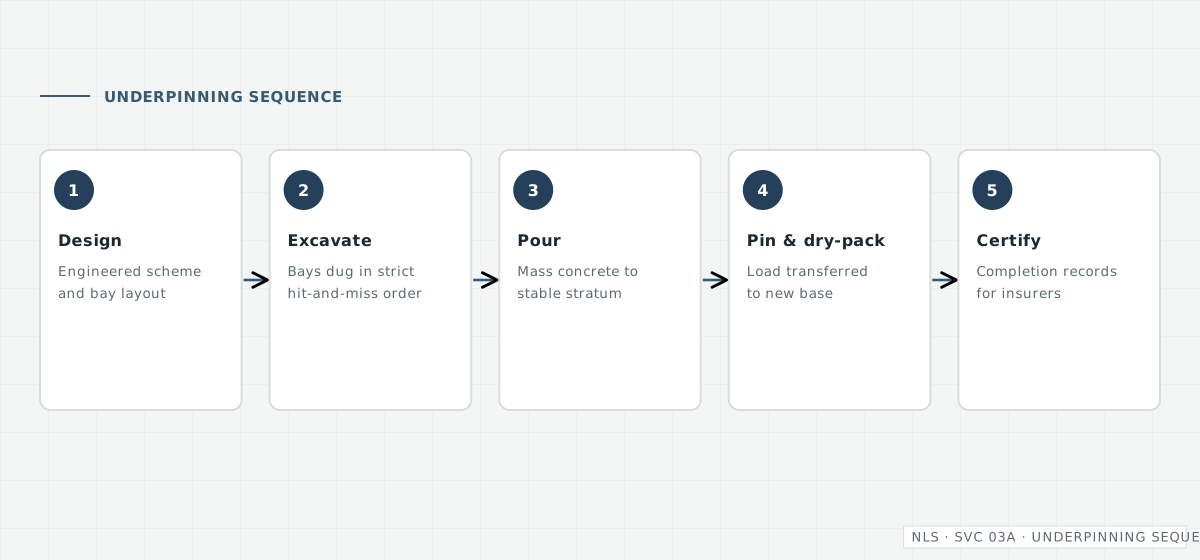
- Confirmation — investigation and monitoring establish that underpinning is the proportionate remedy
- Design — engineered scheme: method, depths, sequence, temporary works; Building Regulations approval
- Party wall procedure — near-universal in terraces; notices, schedules of condition, award
- Works — strict hit-and-miss sequencing (typically ~1m bays, never adjacent bays together); inspection as work proceeds
- Certification — completion documents and certificate of structural adequacy for the permanent file
Timescale: weeks to months on site depending on extent; the sequencing that keeps the building safe cannot be rushed.
Living with an underpinned house
Properly designed, executed and certificated underpinning is a permanent fix that mainstream lenders accept. Practical notes: insurers may load premiums or prefer continuation with the incumbent insurer; partial underpinning creates a stiff/soft boundary that occasionally shows as minor differential movement at its ends; and the documentation is the asset — every future sale will ask for it. An underpinned house with a complete file typically transacts normally; the same house with lost paperwork fights every step.
This guide provides general information only and is not formal structural advice for any specific property. The cause of movement or damage should always be established by proper professional assessment before repairs are commissioned.