Can a leaking drain cause subsidence? Yes — it's one of the leading operative causes in UK subsidence claims. Escaping water softens clay and washes fines from granular soils beneath foundations, while defective pipes attract the tree roots that accelerate clay drying. The signature is movement localised along drain runs — classically the rear corner of a period house where the gully, soil stack and kitchen drainage meet. A CCTV survey plus engineering interpretation confirms or excludes it, usually within days.
The mechanisms
- Softening — sustained leakage raises clay moisture, reducing bearing strength; foundations sink into weakened ground
- Washout — in sands and gravels, escaping flow carries fines away, leaving voids and loosened ground
- Root attraction — moisture-seeking roots enter defective joints, expanding damage and locally desiccating clay: leak and drought in one package
- Surcharge and blockage — displaced or collapsed runs back up, spreading water where it shouldn't be
Age does the underlying work: rigid clay pipes with mortar or early joints, laid shallow a century-plus ago, moved by the same ground they now destabilise.
Recognising the pattern
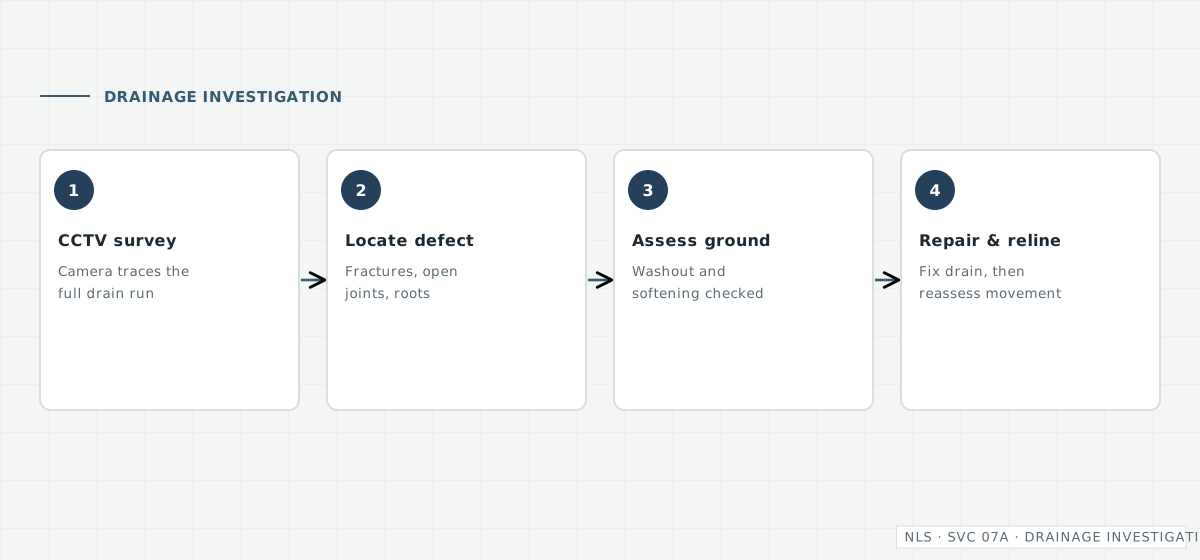
Drainage-driven movement announces itself geographically: cracking concentrated where the drains run rather than distributed structure-wide. Corroborators: sinking paving over runs, a lush vegetation stripe tracing the pipe, recurring blockages, damp at low level near internal stacks, gully surrounds settling. When damage geography and drain geography match, the investigation practically writes itself — which is why the CCTV survey (£150–£400 domestically) is standard first response, and standard insurer practice, in localised-movement cases.
Repair options and sequencing
Patch lining (localised resin sleeve, ~£300–£800 indicative) for discrete defects in otherwise sound pipe; full-run lining for generally degraded but round pipe; excavation and replacement (£1,000–£5,000+ by depth/access) for deformed or collapsed sections. Then the structural sequence: cause fixed → ground stabilises (often monitored through a season) → structural and cosmetic repairs last. Repairing cracks before the ground settles means repairing twice.
Responsibility and insurance
Since the 2011 transfer, most shared drains and all public sewers belong to the water company (Thames Water across this area) — their defect, their repair. Private drains serving only your property within your boundary are yours. Where a private drain's leak caused subsidence damage, buildings insurance ordinarily covers the resulting claim including the operative repair; where movement hasn't yet occurred, drain repair is maintenance, on you — and vastly cheaper done before it becomes a claim. For pre-1950s purchases, a pre-exchange CCTV survey remains the cheapest expensive-surprise insurance available.
This guide provides general information only and is not formal structural advice for any specific property. The cause of movement or damage should always be established by proper professional assessment before repairs are commissioned.